Monday, February 15, 2010
A Perfect Red
I am reading Amy Butler Greenfield´s book, A Perfect Red, which explores the economic and social history of cochineal, an insect that grows on the nopal cactus and is the source of the world´s best, natural red dye. It is a marvelous history, thoroughly researched, easy to read. It opens up the transition between Aztec Mexico and Spanish Mexico in some interesting ways. For example, it describes in great detail the way in which the Spanish stepped in as beneficiaries of the tribute system set up over centuries by the Aztecs; they displaced and replaced the Mexicans at the mouth of a river of cacao, corn, gold, silver, textiles, and cochineal delivered by subjects spread out over a vast geographical area. The book is also enlightening on the social importance of color, particularly red. Highly recommended for anyone interested in the history of the Americas, textiles, the power of fashion, or the economic relationships between the New World and the Old World. If you get really interested in cochineal you can visit Oaxaca where it continues to be produced and used in the dyeing of textiles, particularly the beautiful rugs produced by the weavers of Teotitlan del Valle.

Sunday, February 14, 2010
Comparing Governments
I recently came across this interesting article by Stephen Kinzer published in the Guardian. In it, he compares the rights and services provided to citizens in Cuba vs. those in other non-state socialist Caribbean and Central American countries. As he lays it out, education, security, health care for Cubans, vs. the legal right (if difficult to realize in practice) to freedom of speech and opportunity for poor Guatemalans, Salvadorans, and others, who often live in fear and have little access to health care and education.
It is a more open approach than you often see in the press, posing a question to readers: Which would you choose? A government in control that curtails your freedoms of speech, commerce, and movement but delivers basic services (you can argue the quality of the Cuban services, but the UN´s health statistics show they do much better than most), or a government that extends these rights on paper, but often can´t guarantee them in practice and doesn´t deliver on the services?
The article reminded me of a conversation I participated in when I was doing research in Cuba in 2002. I was at a cafe with a Cuban artist and an American woman who had just arrived in Cuba from a couple of weeks in Guatemala.
¨Wow,¨ said the woman. ¨Cuba is impressive. I don´t see the misery here that I saw in Guatemala.¨
The Cuban painter bristled at her comment. ¨How can you compare Cuba to Guatemala?¨ he began. ¨We don´t have an indigenous population. Everyone speaks Spanish here, unlike Guatemala. We have good infrastructure, much of which was built in the 1950s. We are a small country, with resources, and cultural cohesion. We shouldn´t be compared with Guatemala. We should be compared with Switzerland. And, if you do that...how do we stand up?¨
It was a paradigm adjusting moment for those of us listening. How do you begin to compare nations? What is a fair comparison? What isn´t? And for sure, if Cuba´s freedoms and services are measured against Switzerland rather than against Guatemala or El Salvador or Nicaragua, the perspective changes.
That said, I think that Kinzer´s question is provocative: If you had to choose, which would be more important to you? The freedom to get the health care you need when you need it, or the freedom to say and publish what you think about your government?
But maybe framing the question this way, as the Cuban painter suggested, is misleading and gives weight to a false dichotomy. What do you think?
Friday, March 27, 2009
Overheard: ¨La Gringa¨
When Hillary Clinton visited Mexico City this week she stayed in the, currently unoccupied, US Ambassador´s mansion on Paseo de La Reforma. The security was so overwhelming that people driving home from work moved at a crawl, adding an hour or more to their commute. Later, Reforma heading east toward the city Centro, was closed altogether. A friend, as he was being diverted from Reforma to the much less pleasant artery, Constituyentes, leaned out his car window to ask a cop what was happening. The cop made a desultory jab over his shoulder with his thumb, pointing down the road: ¨Es por La Gringa, jefe.¨ It is because of The Gringa, boss. In other word, Hillary.
Thursday, March 26, 2009
Insidemex.com report on Hillary´s Visit
Mexico City - Secretary of State Hillary Rodham Clinton sat center stage at the Palacio de Bellas Artes, flanked by five Mexican scholarship winners to the US, attired in the indigenous garb of their home regions.
"We share a common future," she said of the United States and Mexico, before an audience in an intimate auditorium. "There is no more critical aspect to that future than the young people in both countries."
Clinton's first visit to Latin America as Secretary of State is weighted by tensions caused by the drug war, trucking restrictions on Mexican fleets, and a retaliatory tariff placed on imported American goods to Mexico. Today she concludes the two-day tour in Monterrey; during her Mexico City rounds yesterday, the visit to the white marble palace of fine arts served to stress Clinton's message that Mexico and the United States are "more like a family than two countries."
Click to read more:
http://www.insidemex.com/news-opinion/hillary-clinton-in-mexico-the-us-and-mexico-are-¨like-family¨
Wednesday, March 25, 2009
Hillary Clinton Arrives in Mexico
Secretary of State, Hillary Clinton arrived in Mexico today and appears to be saying the right things. She acknowledged the US demand for drugs and the fact that the US is not stopping arms from crossing the border illegally into the hands of the narcotraffikers. See the New York Times story here: http://www.nytimes.com/2009/03/26/world/americas/26mexico.html
To my mind, she now needs to acknowledge that there is more to Mexico than a drug war and a border. That would have an impact on her talks with the Mexican government, the impressions of millions of Mexicans, and on the US public that is getted the message that all of Mexico is in chaos and at war.
More later after Sec. Clinton´s next public appearance this afternoon.
Tuesday, March 24, 2009
Enrique Krauze on how the US perspective on Mexico is distorted
Op-Ed Contributor
The Mexican Evolution
By ENRIQUE KRAUZE
Published: March 24, 2009
While we bear responsibility for our problems, the caricature of Mexico being propagated in the United States only increases the despair on both sides of the Rio Grande.
http://www.nytimes.com/2009/03/24/opinion/24krauze.html
The Mexican Evolution
By ENRIQUE KRAUZE
Published: March 24, 2009
While we bear responsibility for our problems, the caricature of Mexico being propagated in the United States only increases the despair on both sides of the Rio Grande.
http://www.nytimes.com/2009/03/24/opinion/24krauze.html
Getting Started Again
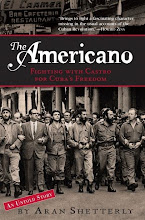
I am going to get this blog started again. Well, started. There wasn´t much happening here when I launched it originally to support my book, The Americano: Fighting with Castro for Cuba´s Freedom. But, now I have lived in Mexico for three-and-a-half years and want to extend the scope.
Subscribe to:
Posts (Atom)


 Posts

